
The Fleetpin platform processes millions of GPS data points every day, applying multiple stages of validation, correction, and interpretation to ensure the highest possible accuracy. This document outlines the key steps involved in processing GPS data and explains how the resulting information is presented to users.
Overview of GPS Accuracy
GPS relies on a network of satellites that continuously broadcast precise time-stamped signals. A GPS receiver measures how long these signals take to arrive, converts that timing into distance, and then uses trilateration with at least four satellites to calculate its three-dimensional position and clock offset.
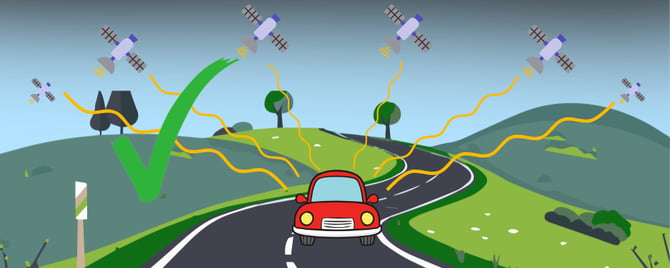

Under ideal open-sky conditions, standard civilian GPS typically achieves accuracy within approximately 3–10 metres (Fleetpin devices are in the range of 2.5 - 5 metres). Several factors influence this accuracy, including satellite geometry (how well-distributed the satellites are overhead), atmospheric effects, signal reflections from buildings or terrain, antenna placement, and the device’s onboard processing algorithms.

In more challenging environments - such as urban canyons, dense foliage, or areas with reflective surfaces - signals may be blocked or delayed due to multipath interference. These distortions can cause the reported position to shift slightly in any direction, resulting in momentary deviations from the vehicle’s true location.

Telematics Devices
Fleetpin telematics devices use proprietary GPS processing algorithms within their firmware. These devices typically obtain GPS fixes at a rate of 1 Hz, providing one validated position per second.
The firmware performs several quality control checks, including discarding invalid or low-confidence fixes, applying light filtering only where appropriate, and suppressing obvious GPS drift when the device is stationary. These measures are designed to improve overall data reliability while preserving the integrity of the underlying GPS information sent to the Fleetpin platform.
Ingestion of Telematics Data
Fleetpin telematics devices report GPS position quality using two primary attributes: HDOP (Horizontal Dilution of Precision) and the number of satellites used in the position fix.
HDOP indicates how satellite geometry affects the accuracy of a horizontal GPS position. Lower values reflect better satellite alignment and therefore higher confidence in the reported coordinates. An HDOP of around 1.0 is considered ideal. For reliability, Fleetpin discards position reports with HDOP values above a defined threshold (typically 2.0). Alert messages are exempt from this filtering and are retained regardless of HDOP.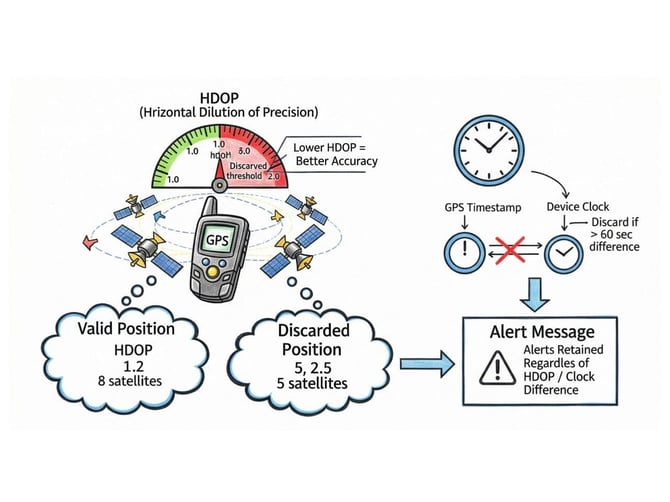
Each reported position is also validated against the device’s internal clock. If the difference between the GPS timestamp and the device clock exceeds 60 seconds, the position report is discarded, although any associated alert messages continue to be processed. In these cases, alerts are preserved, but the corresponding location may be marked as low confidence or excluded depending on the context.
Speed and GPS accuracy
Additional, more stringent GPS quality filtering is applied before generating speeding incidents shown in the Overspeed and Harsh Driving reports. This is necessary because low-accuracy GPS positions can result in false positives, either by reporting an incorrect speed or by placing a vehicle in the wrong speed zone.
.jpg?width=670&height=503&name=Telematics%20data%20validation%20(1).jpg)
To perform this filtering, Fleetpin uses a quality score derived from two accuracy metrics: HDOP (described above) and the number of satellites used in the fix. In practice, neither metric is sufficiently reliable on its own, so they are combined. The quality score is calculated as the number of satellites divided by the HDOP value. This reflects the general rule that higher satellite counts and lower HDOP values indicate better positional confidence. If the resulting score is less than or equal to 5.5, the GPS position is treated as too low-quality for speeding analysis and is excluded from Overspeed and Harsh Driving calculations. The subsequent position from the same device is also excluded, to prevent any residual inaccuracy from influencing results.
Speeding incidents are determined using data from the New Zealand national speed limit register, which is cross-checked against additional public sources to help ensure accuracy. Further heuristics are applied where appropriate, including snapping the vehicle’s reported position to the road segment on which it is travelling.
Recommendations for interpreting telematics GPS data
Due to the inherent nature of GPS, Fleetpin always advises all customers to take care interpreting information and taking actions based on information derived from telematics data.
Treat GPS positions as “close approximations,” not exact points
Fleetpin devices typically specify an accuracy of 2.5m, but small shifts are normal. Seeing a vehicle slightly off the road or in the wrong lane is often just normal GPS drift. Generally, users should focus on patterns over time rather than single points, especially in areas with trees, buildings, or hills that affect signal quality.
Be cautious when interpreting speeding events
Short spikes above the limit can be false positives caused by brief GPS errors or signal reflections. More reliable indicators are sustained speeding over several consecutive data points or speeding recorded with strong satellite coverage. When in doubt, treat isolated spikes as noise unless they form a clear, consistent pattern.
Avoid disciplinary decisions based solely on raw GPS tracks
GPS is a valuable tool for understanding trends and behaviours, but it isn’t perfect. Before taking action with an employee or driver, cross-check events (duration, repeated behaviour, location context) and, where possible, compare against other data such as known travel routes, vehicle telemetry, or driver explanations. Use GPS as supporting evidence - not the only evidence.
Communicate the limitations clearly within your organisation
Users should understand that GPS is excellent for fleet-level insights and behavioural trends, but not for certifying exact lane position, exact speed at a single moment, or pinpointing fault in an isolated incident. Interpreting data with this context leads to fairer, more accurate decisions.
More Information
If you have any further questions or queries regarding telematics data validation please contact us on 0800110820, flick support an email or use the purple chat bubble.